Through Many Struggles, Faith

By Deacon Greg

Genesis 2:15-17; 3:1-7; Romans 5:12-19

Matthew 4:1-11; Psalm 32

    In listening to our Gospel reading this morning on the 1st Sunday of Lent, how many of us see this story as Jesus having a debate with Satan, and at the end, “Jesus wins!” Hooray Jesus!!? How many?

   It shouldn’t be surprising that we all have this perspective after centuries of guilt theology, but I hope that I can bring to you this morning a different perspective of a deeper meaning that connects each one of us to this very human Jesus.

   In meditating and praying on the opening verse from Matthew, I realized that this translation can be misleading. It says “Jesus was led up by the Spirit into the wilderness to be tempted by the devil.” Have you ever been “led up by the Spirit” to go some place?

   Imagine saying to your spouse or parent, “I was led up by the Spirit into the shopping mall today to be tempted by the devil with all those advertisements, and ended up spending $5,000!” Does that sound believable? That sounds more like that character Geraldine that Flip Wilson used to play—you know, the woman who was always saying “The Devil made me do it! The Devil made me buy this dress.” (YouTube Flip Wilson The Devil Made Me Buy This Dress).

   God does not “lead us” into sin. Even in the Lord’s prayer we use each Sunday we suffer from a 16th Century King James, Shakespearian English translation of “Lead us not into temptation, but deliver us from evil,” which in the Book of Common Prayer (p.364) has a modern-day English rendering of “Save us from the time of trial, and deliver us from evil.”

   Does that give you a different perspective? “Save us from the time of trial!”

 
 
We know we face regular trials in this life, some of us on a daily basis. 

   Here we are praying to God “Save us from the time of trial!” “Help us get through this, God. Help us remember you are walking with us. Let us not lose hope!”

   “Save us from the time of trial, and deliver us from evil” feels to me like a very personal response between two loving beings—between God and each one of us.

   Isn’t that what our relationship with God is? God is not a vengeful judge, but a loving parent. Save us, dear God, from the time of trial, and deliver us from evil whenever it assaults us.

   When we pray or sing the traditional Lord’s Prayer, try grasping in your minds this more personal one: Save us from the time of trial!

    Likewise, I would like to suggest a different way to see the opening verse of today’s Gospel. Instead of “Jesus was led up by the Spirit into the wilderness to be tempted by the devil,” try “Jesus was inspired by the Spirit to go off alone to listen to God’s call, and to struggle with his own human weaknesses.”

   How often do each of us struggle with our own weaknesses? Jesus, too, has faced these struggles!

   At his baptism in the Jordan, Jesus heard God tell him “You are my beloved.” In hearing this, Jesus, with a desire to deepen his relationship with God, separated himself from the day-to-day world to spend time—40 days!—focusing on God.

   In that time in the wilderness, where resources are scarce, Jesus inevitably encounters his own human needs and desires—desires that call for humans to focus on “me, myself, and I”—rather than on what God lovingly calls us to do.

   Notice, though, how Jesus overcomes his selfish, human desires, by grasping onto the words of God: “One does not live by bread alone…”; “Do not put the Lord your God to the test”; “Worship the Lord your God, and serve only him.”

   The deeper meaning of today’s Gospel is that in listening to God’s call, Jesus overcomes his all-too-human side of “It’s all about me”, and transforms his inner self into “It’s all about all of us, and it’s all about God.”

   In Jesus’ day the faith of the Pharisees and Sadducees focused on counting up sins and sacrificing animals. St. Paul tells us that Jesus has already wiped away our sins through his death on the cross. There is no need for us to keep an accounting ledger to total up our sins.

   Sin is not an abstract number to be added up, but instead are those things in our lives that keep us separated from God:

·       Things like greed,

·       thirst for power,

·       lust,

·       addictions of all kinds,

·       hatred of others—

     There seems to be an unending list in this world of the ways people separate themselves from God. Should we focus on sin, or focus on God?

   This is what the Season of Lent is all about:

·       It’s a time for us to introspectively examine our lives and struggle with our inner demons that lead us off the path to the Kingdom of God.

·       It is a time not only for introspection, but also in building our inner resolve to expel the demons within us by choosing a different way of using our time in this life.

   I read a quote the other day from an author, David Viscott, a psychiatrist, from his 1993 book “Finding Your Strength in Difficult Times: A Book of Meditations”. He wrote, “The purpose of life is to discover your gift. The work of life is to develop it. The meaning of life is to give your gift away.” That sounds to me like a great definition of our call during Lent.

   Through our new life in Christ, a life where God says to every one of us “You are my beloved,” we are called to live a life focused on mercy and justice, and living God’s dream of bringing the Kingdom of Love into this world.

   In this Season of Lent we are called to examine the things in our lives that keep us separated from God. Jesus spent 40 days in prayer and introspection. Could you spend 40 days? How about 40 minutes each day for 40 days?

   How can you find your inspiration? A book to read? In Prayer? In Meditation? Will it be a combination of something? Find something to inspire you! Set aside the time! And as you live through this time of lent, remember that after Jesus spent 40 days in the wilderness, he started a ministry that changed everyone’s life. What are you called to do?

   I leave you with this Lenten reflection from "The Saint Helena Breviary":

Then let us also keep this Lent

With watchful and devout intent,

That, vigilant, we may prepare

Our hearts for God’s redeeming care.**

As by our lapses we offend

O you who love us, truest friend;

Forgive us, Jesus, our offense;

Teach us a new obedience.

Let all the world for evermore

You, gracious Trinity, adore;

And may we spend these forty days

In seeking you and singing praise. Amen.

 

Blessed Are Those Who Struggle

By Deacon Greg

Micah 6:1-8; 1 Corinthians 1:18-31

Matthew 5:1-12; Psalm 15

    I must confess I find the word “blessed” as used in today’s reading of the Beatitudes to be challenging. After all, do you feel “blessed” when you’re mourning the loss of a loved one? Are you counting your “blessings” when you’re being persecuted or mistreated for living you faith?

   In fact, when you review this list of Beatitudes they seem to describe how this world really “isn’t”.

·       Do the meek, in this day and age of ruthless capitalism, inherit anything?

·       Are the peacemakers celebrated anywhere, except maybe with a Nobel Prize?

·       Where is mercy when our news media thrives on blame?

   If these ramblings aren’t puzzling enough, exactly who are these “poor in spirit”? For years, I stumbled around wondering about the “poor in spirit”.

·       If you don’t have money, does that make you lacking in spirit?

·       If you don’t pray enough does your spirit run out?

·       If you pray too much does that make you rich in spirit?

   As a numbers kind of guy, and as a former Roman Catholic who was supposed to be counting up one’s sins, I was stuck in this idea of finding a numerical solution to this “spirit” question.

   I finally found the answer in a book I read recently, “The Beatitudes through the Ages” [Eklund & Allison Jr.].

   Have you ever in your life struggled with your faith?

·       Have there been times when you have doubts about God’s interest in your life?

·       Can you think of times that you found it easy to be untroubled about faith and that God was sitting right next to you,

·       and other times it seemed that God was a distant concept?

   I know I have, and I’m guessing many of you have struggled the same way.

   If you’ve struggled with your faith, then I have Good News for you today: You are the poor in spirit! Yours is the Kingdom of Heaven!

   “How can this be, Deacon?” you might say, or “What the heck are you talking about, Deacon?”, yet I tell you, “Yours is the kingdom of heaven!”

   The “poor in spirit” are people who regularly struggle with their faith. We are people with questions on our mind, and as soon as we find the answer to one question, we find even more questions to think about! Yet it is this struggle within each of us that God finds endearing.

·       We haven’t settled on a doctrine, and then memorize words until they are rote!

·       We aren’t recording machines that play back whatever is recorded from someone else!

   We are humans who are seeking God, and seeking the Truth, and we leave our minds open not because we are failing as Christians, but because our hearts, minds, and spirits are yearning for God, searching for the Truth, on a daily basis.


   In essence, we are poor in spirit, but rich in perseverance. Isn’t that what our parish life has been like recently here at St. Paul’s?

   God dearly loves all of us who struggle because we have not given up on seeking the path to the Kingdom. Blessed are all of us, for the kingdom of heaven is ours!

   In Jesus’ sermon on the mount, he isn’t telling us what heaven is like, (although it IS what heaven is like), but instead he’s inviting his followers to a new way of living in this world that will bring God’s Kingdom into this broken existence.

·       Blessed are the poor in spirit—We should struggle in our faith!

·       Blessed are those who mourn—We should give comfort to those who are mourning!

·       Blessed are the meek—We should live without arrogance or disdain for others.

·       Blessed are those who hunger and thirst for righteousness, and those who are merciful—We should be working in this world to bring mercy and justice for all of those outcast!

·       Blessed are the pure in heart—We should be striving in our prayer and worship life to open ourselves to faith, hope, and love, and not greed, power, and hate.

·       Blessed are the peacemakers—We should strive to bring peace to the world, and support those who work for peace.

·       Blessed are those who are persecuted and reviled for following the path of Jesus—We should take heart in knowing we are God’s beloved when people hate us for loving everyone.

   You are God’s beloved when people hate you on the basis of who you love, or the color of your skin, or the gender of your true self.

   The Beatitudes are more than just a promise of what will happen “some day”. The Beatitudes are a guidebook for living our spirit-filled life in this world, and the God’s Dream of how this world is meant to be.

   The prophet Micah, in this morning’s reading, tells us about the Dream of God:

“He has told you, O mortal, what is good;

and what does the Lord require of you

but to do justice, and to love kindness,

and to walk humbly with your God.”

   Blessed is this parish that perseveres in following Jesus in the way of love.

   Blessed are each one of us who keep struggling along the path of faith.

   “Rejoice and be glad, for our reward is great in heaven…”

Amen.


An Epiphany Journey: Lost, then found.

By Deacon Greg 

Psalm 72:1-14; Isaiah 60:1-6; Ephesians 3:1-12; Matthew 2:1-12

     In the time of Jesus, Mary, and Joseph, the Wise Men, or Magi, were the leading scientists of their day, studying astronomy, alchemy, and biology in an effort to gain knowledge and understanding of the world around them.

   Rulers of kingdoms would have engaged their services to help discern the future, and provide advice on the policies of the day, much as governments today hire experts, like economists and physicians.

   We don’t know where they came from, other than “the East”, but a good guess might be around modern-day Tehran in Iran. These Magi were people of means since they were able to travel more than 1,000 miles to journey to Jerusalem, most likely with a caravan bringing soldiers and retainers, and projecting the idea of their wealth and power.

    The fact that they walked out of King Herod’s court unharmed after claiming to be seeking the newborn “King of the Jews” is evidence enough that even King Herod, a man who was comfortable with murdering his wife and children for suspicions of plotting against him, was impressed with their power and connections.

   It’s important to remember these Magi were not believers in the God of the Israelites. They had a belief that outside forces, like planets and stars, controlled human being’s destiny. Modern day astrology columns in the local papers are descendant from the Magi’s beliefs.

   Yet these learned Magi were open to seeking the truth wherever it would lead them. In other words, they weren’t exactly sure where they were headed, but they went on the journey anyways. What does that say to us this morning?

    The Magi started off on their journey following a star as their guide, but notice how they lost sight of their guide when they came to Jerusalem.

   Near the end of Herod the Great’s rule, Jerusalem was a beautiful city on the hill, with the 2nd Temple nearing completion, the great expansion of the Temple Mount finished, the huge palaces of Herod and the Romans gleaming bright, and a city that was bustling full of trade and wealth. “Surely,” the Magi thought, “this must be the place!”

   It doesn’t take the Magi long to realize, however, that they’ve made a grave mistake. They are eyewitnesses to the decline of Herod--his health; his paranoia; his immorality--but they are shrewd enough in court intrigue to obtain the prophecies from Herod’s own experts and leave with their lives intact.

    Notice, though, it’s only when the Magi leave Jerusalem, with its display of earthly wealth and power, that they find the star leading them again to a stable in Bethlehem.

       ·       How often in our own lives do we lose sight of the Gospel of Truth as we                are blinded by the wealth and power of our own day?

·       How often do we lose our own way on our journey to the Kingdom of God?

·       How often do we let the Gospel of Jesus just become a story in the back corner of our minds, and let the false glow of money and power in this transient world become the reality of our existence?

    Without hesitation, and “overwhelmed with joy” the Magi walk into the stable of Bethlehem bringing their king-worthy gifts to worship a baby lying in a feeding trough. There is no display of wealth and power here. The only guards present are cows and sheep. The only throne is a bed of straw.

   Yet not even understanding who God was, not even being members of the “Chosen People”, these Gentiles still find God in their thirst for the knowledge of truth in a stable in rural Bethlehem.

    In our journey through life each human has been given an inner yearning to discover the knowledge of truth—to find that inner peace that brings meaning to our lives and hope for our future. As followers of the Gospel we don’t have to study the stars or go on a long journey to find this knowledge as the Magi did two millennia ago.

   We are given this knowledge freely through the Good News of Jesus: That all of us “have become fellow heirs, members of the same body, and sharers in the promise in Christ Jesus,” as Paul tells us in today’s reading.

    The “riches of Christ” are not found in the gold and silver of this life, but in the promise of the Kingdom of God—the Kingdom of Justice and Mercy—the Kingdom that will restore this world, and each of us, to new life living in the original Dream of God

·       a Dream of Love;

·       a Dream of Mercy;

·       a Dream of Inclusion where everyone is welcome

·       a Dream of what this world should be now, but isn’t, because of the human corruption of wealth and power.

   Can you imagine that dream of God? Can you live that dream?

       Isaiah foretold the message of the Magi, and of us:

  " Our light has come, and the glory of the Lord has risen upon us.

   Now we can see and be radiant; our hearts can thrill and rejoice,

   Because the abundance of creation has been brought to us,

   And the wealth of heaven has come to us."

    As we journey on our way from this stable in Bethlehem, let us hold in our hearts the love and promise of Christmas. Let us strive to make every day a day of joy and gratitude. Let us live every day searching for that baby in the stable in the eyes of every person we meet.

   It is only in grasping onto the Dream of God that we can find peace and purpose within each of our hearts and lives.

   May every one of you find fulfillment in your journeys in the year ahead.

Amen.

Wearing the Collar--Living this New Life

New Life in a Clergy Collar

   For most people, when thinking of the Deacon they picture them in their roles assisting or presiding at the Liturgy, or Offices (Morning and Evening Prayer, for instance).
   In reality, though, the Deacon's main concern is focused on the needs of the community, both inside and outside the Church. Deacons have a desire to bring the Kingdom of God into this world by searching for those who are lost or ignored and bringing them back into the community, whether it's the Church or society.
   How does one satiate this desire to expand God's Kingdom, however, when working a full-time job? This question has been the greatest challenge for me since I've been ordained, particularly since my job requires extensive travel.
   As I meditated on this inner tension between supporting my family and serving
as a Deacon in the world, I thought of Paul of Tarsus, the original traveling servant. 
   Paul supported himself working as an itinerant tent maker, and presumably needed to focus much of his time on his secular career, with only weekly times of Sabbath open to spreading the Good News. Perhaps he collected some followers in his day-to-day activities, like going to the shoreline to wash or dye some fabric.
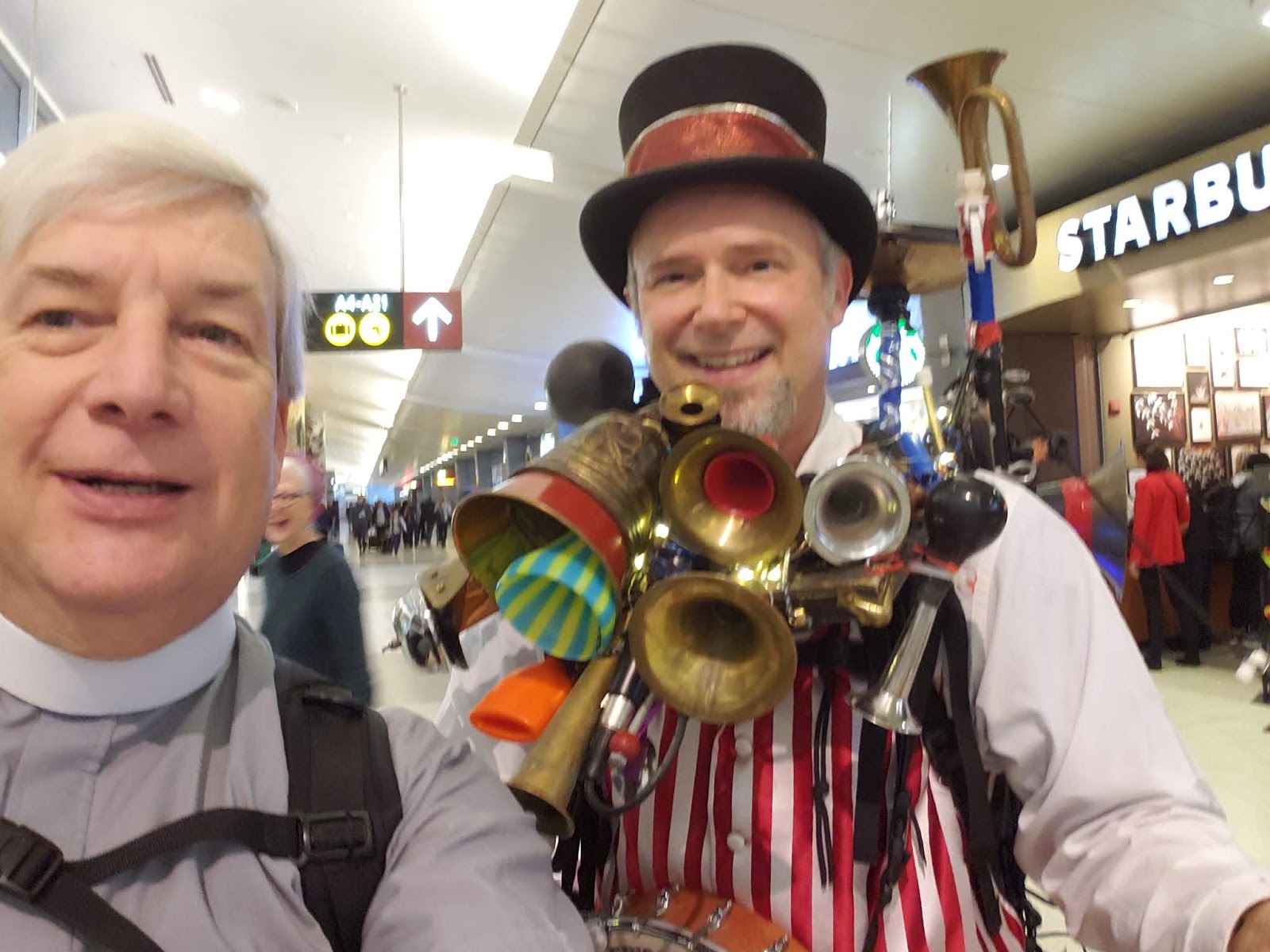
   As I thought about this more, I wondered how I might encounter people along the way. I realized that I had opportunities while I was traveling to perhaps bring some light or calmness to the people I encountered. I decided I would make myself available to people while wearing my clergy shirt and collar.
   My first efforts at this were in the weeks leading up to Christmas 2018. I had numerous flights between Seattle and San Francisco, and drives along Interstate 5 in Oregon and California. 
   The first challenge for me was not to isolate myself, as many of us do, by being focused on technology like smart phones and devices, or closed off with headphones and earbuds. By being focused outward, rather than inward, I encountered interesting reactions from fellow travelers. 
   Some would see me and quickly glance away. I wondered whether it was pain from a past encounter of clergy (how often we've heard of this in today's world!), or just an automatic response of rejection or isolation.
   Some people nodded and smiled as they continued on, while others stopped to have a conversation. During the Holiday Season many people who are unaccustomed to airports and the ensuing crowds find this part of the Season to be nerve-wracking. They seemed to relax by just having someone to talk to, even when it isn't an overtly religious conversation. A smile and an open ear can go a long way to sharing a calm peace between strangers.
   At one point I was sitting near my gate when a group of young adults (20-somethings) came along, and I moved over to give them space to sit together. When one of their waylaid members came walking up some minutes later looking at a clergy person sitting next to their group of friends, one of their friends piped up with "We were waiting for you to catch up before we started the service" and we all had a good chuckle. 
   It is in these brief encounters of socialization that one can find the mysterious sharing of the Spirit. Jesus said "Where two or more are gathered in my name, I am there." Bursts of the Kingdom's Light springs from a loving sharing between people.
   As I travel along the Way, I also have come to notice those who also wear their faith--women with hijabs, religious sisters with their habits, turbans worn by those of Hindu or Islamic faith, or hats or yarmulkes worn by those of the Jewish faith. All have one thing in common: a deeply held conviction of their own faith with a desire to live their lives within that faith.
   Wearing religious garb as you're out in the world makes you constantly examine how you are living and behaving. What would people think of a clergy person driving unsafely? Imagine a nun cutting a person off at the supermarket checkout. How would you react?

 A funny thing happens as you wear the clothing of your faith: that inner calm that you hold within your prayer life leaks into the world as you live it. Being stuck in traffic becomes an opportunity to meditate, or take a minute to appreciate the world around you. Desiring to live with an open heart to God leaves you open to consider the brokenness of the world around you. 
   As we live our lives, Christians pray "May your Kingdom Come, and your will be done on Earth (like it is in heaven)". Living your faith, even without religious garb, opens this world to God's love. In essence, you become part of the Light of God's Kingdom. May you be blessed by God as you travel carrying that Light. Amen!

Discerning Vocation

Discerning as a Deacon or Priest

   I am often asked the question "Are you going on to become a priest? You'd be wonderful at that!" While I feel honored that people would like me as their priest, that is not the vocation I feel deeply called to follow.
   In the Episcopal Church there are three ordained orders: Bishop, Priest, and Deacon. Each role has a special place in the structure of our Church. A Bishop provides leadership and guidance to the parishes within their Diocese, and sometimes outside the Diocese. A priest provides the same kind of leadership and guidance within the parish (or other organization) they may be assigned to shepherd.
   The Deacon has a unique role within the Episcopal Church. This vocation has only recently been reinstated as a full and unique order thanks to the 1979 revision of the Book of Common Prayer, but dates back to the time of the Apostles, with the Act of the Apostles reporting the appointment of the first seven deacons, including Stephen and Phillip.
   While Diocesan Delegates elect their Bishop, and a Parish calls their Priest by an election at a parish meeting, Deacons are appointed by the Bishop to serve where the Bishop sees a need. Most Deacons are not paid a salary, and are either retired, or support themselves through secular employment (as I do).
   This appointed, non-paid position gives the Deacon a certain freedom of action to follow where the Spirit is calling the Deacon, and their community, to go. It is this freedom of action within the Spirit that really spoke to me about following this path.
   Don't hear me wrong! This freedom doesn't give the Deacon a license to do or say whatever they want!! Deacons serve under the guidance of the Bishop, and also must carefully consider the needs and concerns of the community within the Church as well as the community outside the Church.
   At the central core of any Deacon must be a life of prayer and study that focuses the Deacon's innermost being on listening to what God is saying through the Spirit. Any good formation program for Deacons helps the student find that central, intersecting point where the Deacon is open to the needs of the Church, the calling of the Spirit, and needs of the community. 
   One of the fascinating characteristics of Deacons I've discovered is how each of them bring something with them from their secular careers into the Church, and how that skill is then transformed into service for God's people that was never anticipated before. (For just one example, take a look at The Hub in Stockton, CA https://diosanjoaquin.org/the-hub/ )
   Deacons are inside the Church, but also outside the Church. Deacons work at careers of their own, but also live a vocation of their own. Deacons speak from the pulpit, but also speak on the street corner, or in government meetings, or at social gatherings.
   Deacons roles continue to evolve within the Church, and Deacons are constantly listening for the guidance of the Spirit.
   I often connect my life as a Deacon with the life of St. Paul, who worked as a tent maker while spreading the Word of Jesus throughout the Mediterranean world. People were not always happy with his admonitions, but they understood his commitment to his call. At times I wonder how often he made or repaired a tent as a gift to someone in need.
   Since this role of Deacon within the Episcopal Church continues to evolve, I highly recommend "Unexpected Consequences" (by Susanne Watson Epting) to give those who are interested in exploring this path of Deacon an idea of how the role has grown over the years. 

Ordination

Ordination to the Sacred Order of Deacons

   After many years of walking the path, after many hardships and challenges, after many struggles, both internal and external, on December 1, 2018 I reached the guidepost that is the end of one part of the journey and the beginning of another...


”They came to Jericho. As he and his disciples and a large crowd were leaving Jericho, Bartimaeus son of Timaeus, a blind beggar, was sitting by the roadside. When he heard that it was Jesus of Nazareth, he began to shout out and say, “Jesus, Son of David, have mercy on me!” Many sternly ordered him to be quiet, but he cried out even more loudly, “Son of David, have mercy on me!” Jesus stood still and said, “Call him here.” And they called the blind man, saying to him, “Take heart; get up, he is calling you.” So throwing off his cloak, he sprang up and came to Jesus. Then Jesus said to him, “What do you want me to do for you?” The blind man said to him, “My teacher, let me see again.” Jesus said to him, “Go; your faith has made you well.” Immediately he regained his sight and followed him on the way.”-- Mark 10:46-52 (NRSV)
   How often does our crowded mind keep us from calling for Jesus to free us from our blindness in this world? If our eyes are opened to the light around us, will we, too, "follow Jesus on the way"? 


Struggling on the road to Ordination

Struggle: The distance between Graduation and Ordination

   Having graduated from the School for Deacons in Berkeley I thought the toughest part of this journey was over. Instead I found myself in an in-between phase of "Where am I?" and "Where do I go from here?"
   On June 1st I returned to my home parish of St. Paul's after spending almost a year at my Field Ed parish of St. John's. To my surprise I found St. Paul's had 'moved along' since I was there, as what happens in any organization, particularly one with dynamic leadership and a group of people that are open to growing.
   At the same time I was suffering the loss of all of the parish family I had come to love at St. John's.
   In the midst of this transition I found myself seemingly lost in a heavy fog obscuring the future. What am I supposed to do now? How do I make this work? What are my own expectations and goals? How am I supposed to answer this call?
   At the root of this struggle is the question I couldn't answer when I began this process: How am I supposed to be a Deacon when I already work a
demanding full-time job that involves extensive travel? I felt like I needed to search out the answer to this in order to "begin", but all I could find is frustration, along with what many of us carry in our baggage: self-condemnation.
   I spent months trying to "do something", as if the answer was just in front of
United, SFO
me, or subject to an extensive thought process on my part. While this sounds like a reasonable path to take in the business world, is this what one does pursuing the vocational path??
   After spending months wandering in my 'action mode', I found myself in an airline seat on a flight from North Carolina sitting next to a person who was greatly perturbed. For most of the flight there were heavy sighs, a scowl on the mouth, and constant shifting in the seat. Since I travel so much for work my mind was naturally in work mode--not thinking as a Deacon.
   Nearing the end of the flight, this person started a conversation with me, asking what I do for work. We talked a bit about travel, since we both had occupations requiring many nights away from home.
   He then started telling me how angry he was about the doctors who were forcing him to move his wife out of the house and into a medical care facility. She was suffering from a terminal illness and the care required for her would apparently be less costly in the medical facility. He felt as if they were losing their freedom of choice in managing their own healthcare.
   After he fumed for a bit, I told him about my sister, who had suffered through numerous surgeries and extensive medical care for nearly her entire life. In 2007, at age 46, she received a notice from her insurance company that she had reached the maximum life benefit for health insurance, and was being dropped from coverage. The cost of prescriptions and continuing care far exceeded their monthly income, and rather than leave her spouse bankrupt decided to terminate her treatments. She died three weeks later.
   He had listened intently to my story, and when I had reached the end he said "Well that is certainly a different perspective." Our conversation moved to more mundane things, but clearly the anger against the healthcare professionals had dissipated.
   He was still worried, hurt, and angry at the circumstances of his wife's illness, as any of us are when we struggle with tragedy, but for a short time he was able to voice his hurts with someone else rather than just letting it churn on the inside.
   It was only after I left the aircraft and was rushing to my next gate that I realized "Hey, was that some kind of deaconal moment?" I wrestled with this for weeks afterwards. After all, I hadn't made an appointment to meet this person. I didn't decide "Today I'm not a Deacon, but tomorrow I will be." Instead it just happened in the course of living my life that someone in need was led to me.
   I asked myself "How did that happen?" and then started taking a step back to look at this entire process of becoming a Deacon. I didn't start out thinking "This is what I will do!", but instead was more like "OK, I really don't want to do this--I don't think I can do this--but I will answer your call and just trust in You."

Cedar Swamp Trail,
Cape Cod National Seashore
 I came to the realization that rather than continuing that belief of trusting in God and listening for her voice, which I followed through three years of School, I had moved into 'work mode' trying to make things happen. It is not an easy thing for people to relinquish control, particularly to our God who usually can't be discerned by our physical senses.
   As much as I have lived into this calling since March 2013 when Pastor Kathleen West stopped me to say "You know, you have a call within you!?" I find my most inner, basic self to be like any other person searching for meaning in this world. Sometimes the road ahead is covered with fog, but even in the heaviest of fog one searches for markers, listens for sound, or seeks a light.
   Trusting that God is leading us and is concerned about each one of us helps guide us to inner peace, while opening our hearts to the people God sends our way.
May God's Peace and Love continue to pursue each one of you!
Amen.


Graduation from School for Deacons

Graduation, but not (yet) ordination

   This past Sunday I officially graduated from the School for Deacons in Berkeley, CA. I am only now starting to realize, several days later, just what this means for me. 
   For the last three years of School I have focused on trying to complete assignments for the next School weekend, while also balancing work and family life. I found it necessary to keep my focus on the work that needed to be done three weeks at a time. Otherwise, to look up and see how far it was to go could be discouraging. 
   Suddenly, I find myself at the end, a person transformed by the process of study, work, prayer, and community. I've gone from a Doubting Thomas to a committed disciple. 
   Many people feel a sense of accomplishment after graduation, but I feel, instead, a sense of gratitude for all the times I thought I would stumble and the Spirit kept picking me up. It is in fire that metal is tested and hardened, and it is in this experience that I too have strengthened my faith.
   With School complete my journey now turns back to completing the final Steps to Ordination. Examinations, exams, interviews, and endorsements still lie ahead, but for me the best part is turning inward again to focusing on my own spirituality and prayer life in my continuing discussion with God. Time again for family and rest, but also time for faith.
   On my last School for Deacons Weekend I preached at Morning Prayer on Sunday May 6th. For me it was an opportunity to speak of my experience while hopefully inspiring others who are on this same journey of faith. Here is that sermon:

The Sixth Sunday after Easter
Acts 10:44-48
Psalm 98
John 15:9-17
 In our reading from Acts this morning our God of Surprises again acts in a surprising way. Without the reception of any sacraments, and with just a short sermon from Peter, “the Holy Spirit fell upon all who heard the word”, and Peter’s followers “heard them speaking in tongues and extolling God .” (Acts 10:44) Wow, imagine that kind of response to one of our sermons!
   What strikes me in this scene is what has been left out by the Lectionary. Peter and his followers from Joppa traveled to Caesarea to visit a Roman Centurion named Cornelius. Cornelius “was a devout man who feared God with all his household; he gave alms generously to the people and prayed constantly to God.” (Acts 10:2)
   One afternoon Cornelius is suddenly accosted by an “angel from God” who calls him by name. Acts records that Cornelius “stared at him in terror and said, “What is it, Lord?”” and was told “Your prayers and your alms have ascended as a memorial before God.” (Acts 10:3-4) The angel goes on to tell Cornelius to summon Peter, a man he doesn’t know.
   How many of us have heard God call us by name and reacted with that same feeling of terror, or disbelief? I feel at times like that old Alfred E. Newman cartoon from “Mad Magazine” saying “What? Who, me?”

   It makes me wonder how surprised Moses must have been when he heard his name called from within the Burning Bush (Exodus 3). I can only guess at the terror Elijah felt when God passed him by on that mountain, not in the form of wind, earthquake, or fire, but in the sound of sheer silence (1 Kings 19).

   Peter, James, and John were absolutely befuddled when they went up the mountain with Jesus to meet Moses and Elijah, and then hear the voice of God (Matthew 17). Think about it! They were going to set up a tent for a ghost!

   As pilgrims on this journey of faith we yearn to find God, but become terrified when God suddenly finds us and calls us by name. Like Peter, we are some of the least likely people to become a “Rock”, and then we realize that it is not through our efforts that anything is accomplished, but in God working through us that brings God’s Light into the world.

   Rather than sitting back in his lofty perch surrounded by fiery chariots and hosts of angels, (while dropping in occasionally to scare humans half to death), our God of Surprises comes to meet us in human form through Jesus.
   If being God Incarnate is not surprising enough, Jesus tells us “You are my friends if you do what I command you.” A God who wants to be friends with each one of us! Really? God is my friend, and your friend? The creator of the universe yearns to reach out and embrace each of us? With this realization, can there be any deeper joy?

   Jesus speaks to each one of us when he says “You did not choose me but I chose you” (John 15:16) and sends us out into the world to “bear fruit” by following his command to “love one another.” It’s such a simple command to bring God’s love out to a broken world that seems so lost in darkness.

   Like Peter, James, and John we too have found ourselves befuddled at times as we climbed this mountain called “Holy Hill”. Three years ago, looking up, it seemed like we would never make it, and now, looking back, I still don’t know how we did it. At times it seems like a dream—because it is a dream! Like Martin Luther King Jr. and many others before, we have come to the mountain top and can see the Promised Land, a Land that fills your mind with dreams of a new way of living.
·        I dream of a world where every person is viewed as a valued member of society, regardless of who they are, or where they came from, or who they love.
·        I dream of a place where every child is wanted and loved, has a home to live in and enough food to eat, can get medical care whenever needed, and has access to an education that will help them find their own dream.
·        I dream of a time when every worker, regardless of their occupation, returns home safe every night, earns enough to support their family, and is able to afford the roses as well as the bread.
·        I dream of a day when the Earth is not viewed by humans as a resource to be exploited, but is seen and cared for as part of God’s precious Garden.
   
   These may sound like crazy dreams, but this is the Dream of God that I’ve come to know here. This is the Kingdom of God brought to Earth by Jesus. The cross of Jesus didn’t just open up a one-way street to the next world—The Cross has opened a doorway that also brings God’s Dream for us into this world.
·        Can you see that open doorway?
·        Can you imagine the Dream of God?
·        Can you feel the Kingdom of God drawing near?

   Jesus is calling each one of us: “Come follow me.”
·        Come, follow me out into the world.
·        Come, make what is old new again.
·        Come, heal the broken.
·        Come, find the lost.
·        Come, love one another as I have loved you.
   May the Spirit of God so fill our hearts with the vision of God’s Dream that we become beacons of hope and love in this bruised and broken world.
Amen.

Nearly Finished, Looking Back

Reflections on the Journey

   In the midst of serving at my Parish Field Assignment from Palm Sunday through Easter Sunday, and everything in between, I found myself reflecting on where I've been on this journey through formation.
   It was five years ago on Maundy Thursday that I first attended a service at an Episcopal Church. Growing up Roman Catholic, it was not an easy thing to leave, but I could no longer accept the practice of excluding people from full inclusion. The Jesus I know from the New Testament welcomed all people to his table, even his betrayer Judas.
   I was never divorced, I wasn't a woman wanting to be ordained, I'm not gay wanting to be accepted or married, but the exclusion of all of these groups of people troubled my heart and soul. I could no longer stay in a Church that included me, but excluded others. Jesus opened the Kingdom of God to everyone, tearing down walls formed by man-made religious rules that separated people from each other.
   
It was four years ago on Good Friday that Pastor Kathleen West rushed out of St. Paul's to call me back and told me I had a calling. Sometimes I still think this is a crazy idea. 
   I start thinking that I am somehow the subject of a joke by God, but I just haven't heard the punchline yet. It is times like these my mind jumps to the character Tevye in Fiddler on the Roof. My Tevye prayer would be "OK God! I don't get it yet! Are you going to tell me, or do I have to wait?"
   Now in my last semester at School for Deacons, I have completed (34) School Weekends, with (2) weekends left to go. I have no idea how I've made it this far except by the grace of God. Thirty-four three-week cycles of homework, all in the midst of work and family crises, and challenged along the way with doubts and fears.
   How have I done it? Perseverance is one piece of it, learning to live in one 3-week homework cycle at a time; Fellowship with my fellow seminarian, a woman who has as much stubbornness and drive as me--perhaps more!; The greatest asset of all, however, has been clinging onto faith and trusting that God is leading me on this path and is walking with each of us.
   For the last couple weeks I have been re-reading "Many Servants: An Introduction to Deacons" by Ormonde Plater. I read this book at the beginning of this journey trying to understand deacons. Now, after 3 years of intensive training I read it again with a new perspective, and new understanding.
   Where am I going? I don't know. What is my 'calling'?" I haven't a clue! What will I do? I haven't the foggiest notion. Perhaps in walking this part of the path for the last three years, trusting in God over a long period, I have come to the point of not spending so much time worrying about the future, and instead living in this day--this present--this gift of 'now'. This is one of the hallmarks of the Kingdom of God: trusting that God will lead us to the future, heal us from the past, and walk with us in the present.
   I believe that Jesus' message of love is filled with joy! If you're not laughing with God at least some of the time, you're missing something in life! I am so blessed to have found the "Episcopal Branch of the Jesus Movement". Peace and love!! 
    
Note: Painting by Henry O Tanner

Good Friday & Parish Field Assignment

Good Friday calls us!

   I preached at the Good Friday service this year at my Parish Field Assignment at St. John's in Lodi, CA. Too many people want to jump over the pain of the cross and go straight to Easter Sunday and the Resurrection, but so much is missed by turning away from the pain of reality. It's not about guilt, it is about unbounded love. We are called!
   Here is the sermon:
John 19:1-37

   In a man’s world, women and children don’t count—they are insignificant! I would like to believe this is no longer true, but when you hear how women are treated in the workplace, or how children are afraid of going to school, I have to wonder… The fact remains, however, that in Jesus’ time women and children didn’t count.
   Back then the status of most women was not much better than that of a slave—as wives they were treated as house servants,  and could be divorced and left homeless for any reason. More than half of the children died before the age of 10, and a third of women died in childbirth. Even in the story of the miracle of the fishes and loaves (John 6:10), a crowd follows Jesus, but only the men are counted.
   It is this insignificant status of women and children that is a key point in understanding the truth of today’s reading, and the Gospel of John itself.
   All of the other followers of Jesus have run away and are in hiding, fearful they will be arrested and added to crosses along the road to Jerusalem.

  Abandoned by his followers, beaten and humiliated, stripped of his only possessions, now hanging from a cross as the soldiers get drunk and gamble over his garments, could any human feel any more abandoned and alone? Yet at this lowest point in his life, when his whole ministry must feel like a giant failure, a few of his closest followers, ones considered to be insignificant and worthless by the soldiers guarding the condemned, come and stand near Jesus, helpless to do anything but be with him in his final hours.
   Our Creator is not a god who sits back and watches from a distance—God doesn’t meet us halfway—the Alpha and Omega was born into our world to share in our joys, sorrows, and pain—to find the lost, the broken, and the blind--and lead to us to new life!
   Here we stand at the foot of the cross, at what must seem to the people around Jesus, the end of that life.  The Light of the World is being extinguished by the forces of darkness.
   John recalls that Jesus was crucified on the day before Passover, at the same time the lambs were being prepared for the Passover meal. When Jesus says from the cross “I am thirsty” [19:28] John remembers a sponge was dipped in cheap wine and given to him on a reed of hyssop It was a hyssop reed that was dipped in the blood of the Passover lambs to mark the wooden doors and lintels in Egypt, protecting the Israelites from the angel of death.
   Here John is telling us that the blood of the Lamb of God spread on the wood of the cross in Jerusalem will open the door to eternal life. This one man, Jesus, gives his life out of love for God and each one of us.
   John records that the legs of the men crucified with Jesus were broken to hasten their death, but that since Jesus was already dead they drove a spear into him and “…at once blood and water came out.” [19:34] It is only in modern times that scientists have come to understand that breaking the legs of crucifixion victims caused immediate death by asphyxiation--and that stabbing a live person causes blood to flow out, but blood and water-like fluids flow out of a dead one.
   John’s Gospel is not based on hearsay, or an oral tradition, but is an eye-witness account of real events by a follower of Jesus who was personally familiar with Judea and Jerusalem. If you were there, could you have ever forgotten what you saw in Jesus’ life or his death?
   The Gospel of John records the unintended testimony made about Jesus by his worst adversaries:  the Temple authorities. They don’t deny that Jesus healed the man born blind [9:1-12], but call Jesus a sinner for healing someone on the Sabbath. Their trial proves this man has been healed, but they throw the man out of the synagogue because they are blind to the Truth, and refuse to hear the man’s testimony of Jesus.
   In hearing that Jesus had raised Lazarus from the dead in front of a crowd of witnesses, the response of the Temple authorities is not doubt that it happened, but “This man is performing many signs. If we let him go on like this, everyone will believe in him…” causing Caiaphas to prophetically respond “…It is better to have one man die for the people than to have the whole nation destroyed.” [11:45-50] Salvation from one man, predicted by the high priest.
   Finally, it is Pilate himself who declares Jesus “King of the Jews”. Messiah means Anointed One, or King. Little does Pilate know that Jesus is so much more than King of the Jews.
   Writing his Gospel late in life, John carefully crafts his story not just to testify to the events he witnessed, but to answer the most basic question: What does it mean for us to become followers of Jesus? What should I do? How should I live?
   In the first chapter the un-named disciple who searches out Jesus asks “Rabbi, where are you staying?” [1:38], expressing a curiosity--an openness to hear this Good News. He is baptized and goes on to participate in Eucharistic-like feasts, like the feeding of the 5,000 [6:1-15], growing in his faith.
   At the Last Supper It is the un-named Beloved Disciple reclining next to Jesus. [13:24-25] It is the un-named disciple who slips Peter into the courtyard of the high priest during Jesus’ trial [18:15-16].
   Finally, in the reading we just heard, it is the Beloved Disciple standing at the foot of the cross with Jesus’ mother, her sister, Mary the wife of Clopas, and Mary Magdalene. A teenage boy with the simple faith of a child, and several women with the love of a mother.
   Even in his final moments Jesus is using his last breath to minister to others. He asks the Beloved Disciple to care for his mother whom he is leaving behind.

   Ask yourself “Why doesn’t John name himself in all of these places? Why doesn’t John say “I was there” or “I did this” rather than speaking of himself in the third person?” The answer can be rather jolting: John is inviting each of us to become the Beloved Disciple.
   John’s Gospel is an invitation to each one of us to become committed disciples of Christ—to become Jesus’ hands and feet and voices in the world—to care for those whom Jesus loves: the sick and the dying, the marginalized and the outcasts, the poor and the afflicted; humanity AND creation itself.
   John tells us Jesus said “Just as I have loved you, you also should love one another. By this everyone will know that you are my disciples, if you have love for one another.”
   Becoming the Beloved Disciple means turning away from being centered on the self, leaving behind all of those selfish things that separate us from God and each other. Becoming the Beloved Disciple means living a life centered on God and caring for others; of living in love and hope, and not in fear; of living life with opened eyes and opened hearts listening for the call of the Spirit.
   On this solemn day of Good Friday, and into the morrow of Holy Saturday, the world waits in this thinness between life and death, just as it did back then. Think of how empty the world becomes without Jesus in it!
·        Let us accept John’s invitation to become Beloved Disciples.
·        Let us remember the love and healing Jesus brought into this world.
·        Let us feel for a brief instant the grief these disciples felt in losing their Teacher.

Discipleship calls us to perseverance.
Faith dares us to hope.
Love brings us to new life.
Amen.
Ref: “The Past from God’s Perspective” by Rev. Dr. Scott Gambrill Sinclair

  Through Many Struggles, Faith By Deacon Greg Genesis 2:15-17; 3:1-7; Romans 5:12-19 Matthew 4:1-11; Psalm 32      In listening to ...