Blessed Are Those Who Struggle

By Deacon Greg

Micah 6:1-8; 1 Corinthians 1:18-31

Matthew 5:1-12; Psalm 15

    I must confess I find the word “blessed” as used in today’s reading of the Beatitudes to be challenging. After all, do you feel “blessed” when you’re mourning the loss of a loved one? Are you counting your “blessings” when you’re being persecuted or mistreated for living you faith?

   In fact, when you review this list of Beatitudes they seem to describe how this world really “isn’t”.

·       Do the meek, in this day and age of ruthless capitalism, inherit anything?

·       Are the peacemakers celebrated anywhere, except maybe with a Nobel Prize?

·       Where is mercy when our news media thrives on blame?

   If these ramblings aren’t puzzling enough, exactly who are these “poor in spirit”? For years, I stumbled around wondering about the “poor in spirit”.

·       If you don’t have money, does that make you lacking in spirit?

·       If you don’t pray enough does your spirit run out?

·       If you pray too much does that make you rich in spirit?

   As a numbers kind of guy, and as a former Roman Catholic who was supposed to be counting up one’s sins, I was stuck in this idea of finding a numerical solution to this “spirit” question.

   I finally found the answer in a book I read recently, “The Beatitudes through the Ages” [Eklund & Allison Jr.].

   Have you ever in your life struggled with your faith?

·       Have there been times when you have doubts about God’s interest in your life?

·       Can you think of times that you found it easy to be untroubled about faith and that God was sitting right next to you,

·       and other times it seemed that God was a distant concept?

   I know I have, and I’m guessing many of you have struggled the same way.

   If you’ve struggled with your faith, then I have Good News for you today: You are the poor in spirit! Yours is the Kingdom of Heaven!

   “How can this be, Deacon?” you might say, or “What the heck are you talking about, Deacon?”, yet I tell you, “Yours is the kingdom of heaven!”

   The “poor in spirit” are people who regularly struggle with their faith. We are people with questions on our mind, and as soon as we find the answer to one question, we find even more questions to think about! Yet it is this struggle within each of us that God finds endearing.

·       We haven’t settled on a doctrine, and then memorize words until they are rote!

·       We aren’t recording machines that play back whatever is recorded from someone else!

   We are humans who are seeking God, and seeking the Truth, and we leave our minds open not because we are failing as Christians, but because our hearts, minds, and spirits are yearning for God, searching for the Truth, on a daily basis.


   In essence, we are poor in spirit, but rich in perseverance. Isn’t that what our parish life has been like recently here at St. Paul’s?

   God dearly loves all of us who struggle because we have not given up on seeking the path to the Kingdom. Blessed are all of us, for the kingdom of heaven is ours!

   In Jesus’ sermon on the mount, he isn’t telling us what heaven is like, (although it IS what heaven is like), but instead he’s inviting his followers to a new way of living in this world that will bring God’s Kingdom into this broken existence.

·       Blessed are the poor in spirit—We should struggle in our faith!

·       Blessed are those who mourn—We should give comfort to those who are mourning!

·       Blessed are the meek—We should live without arrogance or disdain for others.

·       Blessed are those who hunger and thirst for righteousness, and those who are merciful—We should be working in this world to bring mercy and justice for all of those outcast!

·       Blessed are the pure in heart—We should be striving in our prayer and worship life to open ourselves to faith, hope, and love, and not greed, power, and hate.

·       Blessed are the peacemakers—We should strive to bring peace to the world, and support those who work for peace.

·       Blessed are those who are persecuted and reviled for following the path of Jesus—We should take heart in knowing we are God’s beloved when people hate us for loving everyone.

   You are God’s beloved when people hate you on the basis of who you love, or the color of your skin, or the gender of your true self.

   The Beatitudes are more than just a promise of what will happen “some day”. The Beatitudes are a guidebook for living our spirit-filled life in this world, and the God’s Dream of how this world is meant to be.

   The prophet Micah, in this morning’s reading, tells us about the Dream of God:

“He has told you, O mortal, what is good;

and what does the Lord require of you

but to do justice, and to love kindness,

and to walk humbly with your God.”

   Blessed is this parish that perseveres in following Jesus in the way of love.

   Blessed are each one of us who keep struggling along the path of faith.

   “Rejoice and be glad, for our reward is great in heaven…”

Amen.

 

An Epiphany Journey: Lost, then found.

By Deacon Greg 

Psalm 72:1-14; Isaiah 60:1-6; Ephesians 3:1-12; Matthew 2:1-12

     In the time of Jesus, Mary, and Joseph, the Wise Men, or Magi, were the leading scientists of their day, studying astronomy, alchemy, and biology in an effort to gain knowledge and understanding of the world around them.

   Rulers of kingdoms would have engaged their services to help discern the future, and provide advice on the policies of the day, much as governments today hire experts, like economists and physicians.

   We don’t know where they came from, other than “the East”, but a good guess might be around modern-day Tehran in Iran. These Magi were people of means since they were able to travel more than 1,000 miles to journey to Jerusalem, most likely with a caravan bringing soldiers and retainers, and projecting the idea of their wealth and power.

    The fact that they walked out of King Herod’s court unharmed after claiming to be seeking the newborn “King of the Jews” is evidence enough that even King Herod, a man who was comfortable with murdering his wife and children for suspicions of plotting against him, was impressed with their power and connections.

   It’s important to remember these Magi were not believers in the God of the Israelites. They had a belief that outside forces, like planets and stars, controlled human being’s destiny. Modern day astrology columns in the local papers are descendant from the Magi’s beliefs.

   Yet these learned Magi were open to seeking the truth wherever it would lead them. In other words, they weren’t exactly sure where they were headed, but they went on the journey anyways. What does that say to us this morning?

    The Magi started off on their journey following a star as their guide, but notice how they lost sight of their guide when they came to Jerusalem.

   Near the end of Herod the Great’s rule, Jerusalem was a beautiful city on the hill, with the 2nd Temple nearing completion, the great expansion of the Temple Mount finished, the huge palaces of Herod and the Romans gleaming bright, and a city that was bustling full of trade and wealth. “Surely,” the Magi thought, “this must be the place!”

   It doesn’t take the Magi long to realize, however, that they’ve made a grave mistake. They are eyewitnesses to the decline of Herod--his health; his paranoia; his immorality--but they are shrewd enough in court intrigue to obtain the prophecies from Herod’s own experts and leave with their lives intact.

    Notice, though, it’s only when the Magi leave Jerusalem, with its display of earthly wealth and power, that they find the star leading them again to a stable in Bethlehem.

       ·       How often in our own lives do we lose sight of the Gospel of Truth as we                are blinded by the wealth and power of our own day?

·       How often do we lose our own way on our journey to the Kingdom of God?

·       How often do we let the Gospel of Jesus just become a story in the back corner of our minds, and let the false glow of money and power in this transient world become the reality of our existence?

    Without hesitation, and “overwhelmed with joy” the Magi walk into the stable of Bethlehem bringing their king-worthy gifts to worship a baby lying in a feeding trough. There is no display of wealth and power here. The only guards present are cows and sheep. The only throne is a bed of straw.

   Yet not even understanding who God was, not even being members of the “Chosen People”, these Gentiles still find God in their thirst for the knowledge of truth in a stable in rural Bethlehem.

    In our journey through life each human has been given an inner yearning to discover the knowledge of truth—to find that inner peace that brings meaning to our lives and hope for our future. As followers of the Gospel we don’t have to study the stars or go on a long journey to find this knowledge as the Magi did two millennia ago.

   We are given this knowledge freely through the Good News of Jesus: That all of us “have become fellow heirs, members of the same body, and sharers in the promise in Christ Jesus,” as Paul tells us in today’s reading.

    The “riches of Christ” are not found in the gold and silver of this life, but in the promise of the Kingdom of God—the Kingdom of Justice and Mercy—the Kingdom that will restore this world, and each of us, to new life living in the original Dream of God

·       a Dream of Love;

·       a Dream of Mercy;

·       a Dream of Inclusion where everyone is welcome

·       a Dream of what this world should be now, but isn’t, because of the human corruption of wealth and power.

   Can you imagine that dream of God? Can you live that dream?

       Isaiah foretold the message of the Magi, and of us:

  " Our light has come, and the glory of the Lord has risen upon us.

   Now we can see and be radiant; our hearts can thrill and rejoice,

   Because the abundance of creation has been brought to us,

   And the wealth of heaven has come to us."

    As we journey on our way from this stable in Bethlehem, let us hold in our hearts the love and promise of Christmas. Let us strive to make every day a day of joy and gratitude. Let us live every day searching for that baby in the stable in the eyes of every person we meet.

   It is only in grasping onto the Dream of God that we can find peace and purpose within each of our hearts and lives.

   May every one of you find fulfillment in your journeys in the year ahead.

Amen.

Wearing the Collar--Living this New Life

New Life in a Clergy Collar

   For most people, when thinking of the Deacon they picture them in their roles assisting or presiding at the Liturgy, or Offices (Morning and Evening Prayer, for instance).
   In reality, though, the Deacon's main concern is focused on the needs of the community, both inside and outside the Church. Deacons have a desire to bring the Kingdom of God into this world by searching for those who are lost or ignored and bringing them back into the community, whether it's the Church or society.
   How does one satiate this desire to expand God's Kingdom, however, when working a full-time job? This question has been the greatest challenge for me since I've been ordained, particularly since my job requires extensive travel.
   As I meditated on this inner tension between supporting my family and serving
as a Deacon in the world, I thought of Paul of Tarsus, the original traveling servant. 
   Paul supported himself working as an itinerant tent maker, and presumably needed to focus much of his time on his secular career, with only weekly times of Sabbath open to spreading the Good News. Perhaps he collected some followers in his day-to-day activities, like going to the shoreline to wash or dye some fabric.
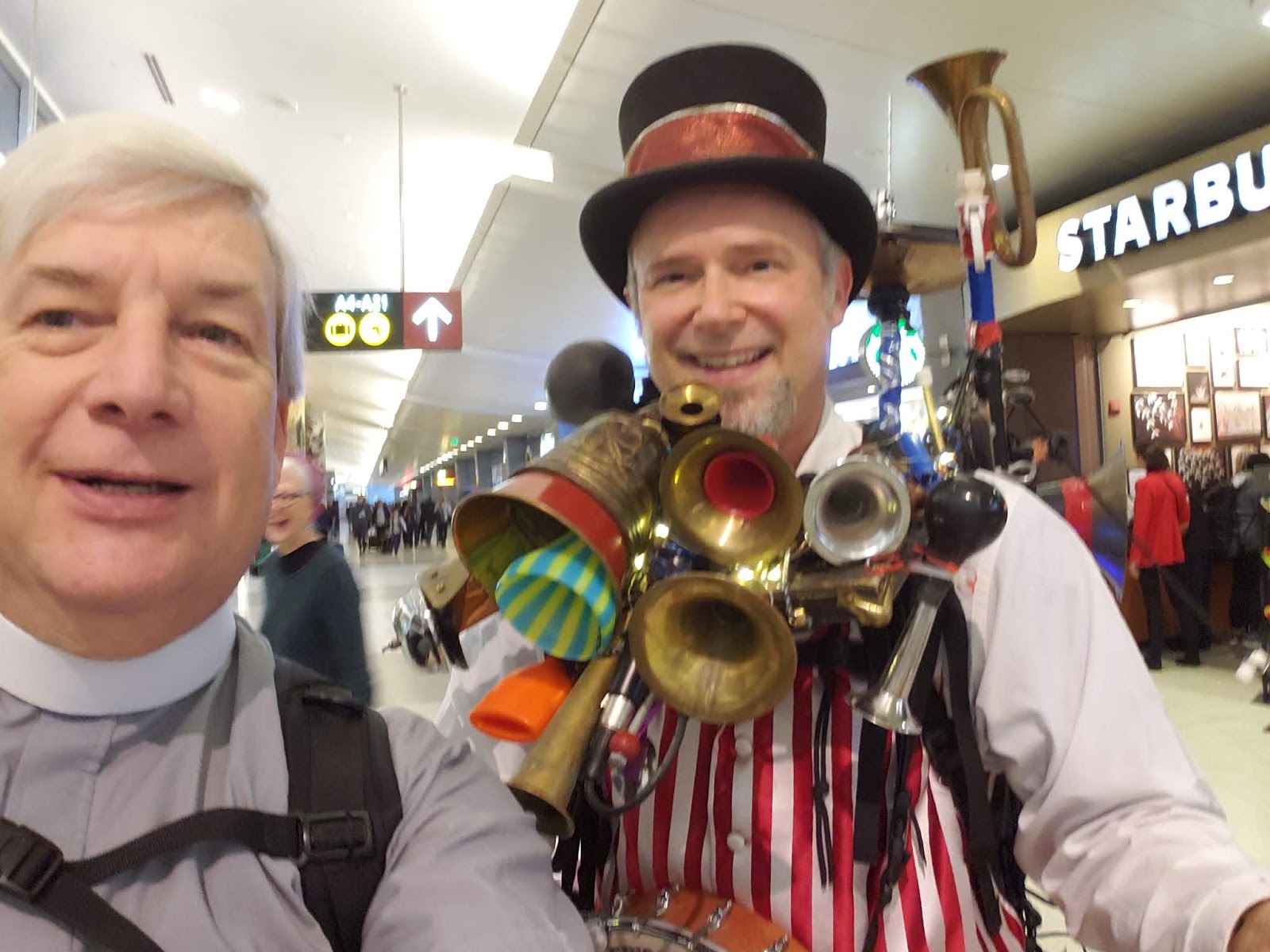
   As I thought about this more, I wondered how I might encounter people along the way. I realized that I had opportunities while I was traveling to perhaps bring some light or calmness to the people I encountered. I decided I would make myself available to people while wearing my clergy shirt and collar.
   My first efforts at this were in the weeks leading up to Christmas 2018. I had numerous flights between Seattle and San Francisco, and drives along Interstate 5 in Oregon and California. 
   The first challenge for me was not to isolate myself, as many of us do, by being focused on technology like smart phones and devices, or closed off with headphones and earbuds. By being focused outward, rather than inward, I encountered interesting reactions from fellow travelers. 
   Some would see me and quickly glance away. I wondered whether it was pain from a past encounter of clergy (how often we've heard of this in today's world!), or just an automatic response of rejection or isolation.
   Some people nodded and smiled as they continued on, while others stopped to have a conversation. During the Holiday Season many people who are unaccustomed to airports and the ensuing crowds find this part of the Season to be nerve-wracking. They seemed to relax by just having someone to talk to, even when it isn't an overtly religious conversation. A smile and an open ear can go a long way to sharing a calm peace between strangers.
   At one point I was sitting near my gate when a group of young adults (20-somethings) came along, and I moved over to give them space to sit together. When one of their waylaid members came walking up some minutes later looking at a clergy person sitting next to their group of friends, one of their friends piped up with "We were waiting for you to catch up before we started the service" and we all had a good chuckle. 
   It is in these brief encounters of socialization that one can find the mysterious sharing of the Spirit. Jesus said "Where two or more are gathered in my name, I am there." Bursts of the Kingdom's Light springs from a loving sharing between people.
   As I travel along the Way, I also have come to notice those who also wear their faith--women with hijabs, religious sisters with their habits, turbans worn by those of Hindu or Islamic faith, or hats or yarmulkes worn by those of the Jewish faith. All have one thing in common: a deeply held conviction of their own faith with a desire to live their lives within that faith.
   Wearing religious garb as you're out in the world makes you constantly examine how you are living and behaving. What would people think of a clergy person driving unsafely? Imagine a nun cutting a person off at the supermarket checkout. How would you react?

 A funny thing happens as you wear the clothing of your faith: that inner calm that you hold within your prayer life leaks into the world as you live it. Being stuck in traffic becomes an opportunity to meditate, or take a minute to appreciate the world around you. Desiring to live with an open heart to God leaves you open to consider the brokenness of the world around you. 
   As we live our lives, Christians pray "May your Kingdom Come, and your will be done on Earth (like it is in heaven)". Living your faith, even without religious garb, opens this world to God's love. In essence, you become part of the Light of God's Kingdom. May you be blessed by God as you travel carrying that Light. Amen!

Discerning Vocation

Discerning as a Deacon or Priest

   I am often asked the question "Are you going on to become a priest? You'd be wonderful at that!" While I feel honored that people would like me as their priest, that is not the vocation I feel deeply called to follow.
   In the Episcopal Church there are three ordained orders: Bishop, Priest, and Deacon. Each role has a special place in the structure of our Church. A Bishop provides leadership and guidance to the parishes within their Diocese, and sometimes outside the Diocese. A priest provides the same kind of leadership and guidance within the parish (or other organization) they may be assigned to shepherd.
   The Deacon has a unique role within the Episcopal Church. This vocation has only recently been reinstated as a full and unique order thanks to the 1979 revision of the Book of Common Prayer, but dates back to the time of the Apostles, with the Act of the Apostles reporting the appointment of the first seven deacons, including Stephen and Phillip.
   While Diocesan Delegates elect their Bishop, and a Parish calls their Priest by an election at a parish meeting, Deacons are appointed by the Bishop to serve where the Bishop sees a need. Most Deacons are not paid a salary, and are either retired, or support themselves through secular employment (as I do).
   This appointed, non-paid position gives the Deacon a certain freedom of action to follow where the Spirit is calling the Deacon, and their community, to go. It is this freedom of action within the Spirit that really spoke to me about following this path.
   Don't hear me wrong! This freedom doesn't give the Deacon a license to do or say whatever they want!! Deacons serve under the guidance of the Bishop, and also must carefully consider the needs and concerns of the community within the Church as well as the community outside the Church.
   At the central core of any Deacon must be a life of prayer and study that focuses the Deacon's innermost being on listening to what God is saying through the Spirit. Any good formation program for Deacons helps the student find that central, intersecting point where the Deacon is open to the needs of the Church, the calling of the Spirit, and needs of the community. 
   One of the fascinating characteristics of Deacons I've discovered is how each of them bring something with them from their secular careers into the Church, and how that skill is then transformed into service for God's people that was never anticipated before. (For just one example, take a look at The Hub in Stockton, CA https://diosanjoaquin.org/the-hub/ )
   Deacons are inside the Church, but also outside the Church. Deacons work at careers of their own, but also live a vocation of their own. Deacons speak from the pulpit, but also speak on the street corner, or in government meetings, or at social gatherings.
   Deacons roles continue to evolve within the Church, and Deacons are constantly listening for the guidance of the Spirit.
   I often connect my life as a Deacon with the life of St. Paul, who worked as a tent maker while spreading the Word of Jesus throughout the Mediterranean world. People were not always happy with his admonitions, but they understood his commitment to his call. At times I wonder how often he made or repaired a tent as a gift to someone in need.
   Since this role of Deacon within the Episcopal Church continues to evolve, I highly recommend "Unexpected Consequences" (by Susanne Watson Epting) to give those who are interested in exploring this path of Deacon an idea of how the role has grown over the years. 

Ordination

Ordination to the Sacred Order of Deacons

   After many years of walking the path, after many hardships and challenges, after many struggles, both internal and external, on December 1, 2018 I reached the guidepost that is the end of one part of the journey and the beginning of another...


”They came to Jericho. As he and his disciples and a large crowd were leaving Jericho, Bartimaeus son of Timaeus, a blind beggar, was sitting by the roadside. When he heard that it was Jesus of Nazareth, he began to shout out and say, “Jesus, Son of David, have mercy on me!” Many sternly ordered him to be quiet, but he cried out even more loudly, “Son of David, have mercy on me!” Jesus stood still and said, “Call him here.” And they called the blind man, saying to him, “Take heart; get up, he is calling you.” So throwing off his cloak, he sprang up and came to Jesus. Then Jesus said to him, “What do you want me to do for you?” The blind man said to him, “My teacher, let me see again.” Jesus said to him, “Go; your faith has made you well.” Immediately he regained his sight and followed him on the way.”-- Mark 10:46-52 (NRSV)
   How often does our crowded mind keep us from calling for Jesus to free us from our blindness in this world? If our eyes are opened to the light around us, will we, too, "follow Jesus on the way"? 


  Through Many Struggles, Faith By Deacon Greg Genesis 2:15-17; 3:1-7; Romans 5:12-19 Matthew 4:1-11; Psalm 32      In listening to ...